Welcome to the fascinating world of bees! In this article on “Bee Anatomy: Understanding the Biology of Pollinators,” we’ll dive into the incredible characteristics that make these buzzing insects so essential to our ecosystem. So, let’s get started and explore the amazing world of bee anatomy!
Did you know that bees have some of the most intricate and specialized body structures in the insect world? From their compound eyes to their unique mouthparts, bees are marvels of nature’s engineering. By understanding their anatomy, we can appreciate how these tiny creatures contribute to the pollination of plants and the production of our food.
So, get ready to uncover the secrets of bee anatomy as we unravel the mysteries behind the buzzing world of these vital pollinators. Join us as we delve into the intricate biology of bees, one fascinating body part at a time! Let’s begin our exploration into the fascinating world of bee anatomy.
Discover the fascinating world of bee anatomy and gain a deeper understanding of these important pollinators. Learn about the intricate biology of bees, from their compound eyes and antennae to their wings and stingers. Explore how each part plays a crucial role in their survival and their essential contribution to our ecosystems. Dive into the amazing world of bee anatomy and unlock the secrets of these incredible creatures.
Bee Anatomy: Understanding the Biology of Pollinators
Welcome to an in-depth exploration of bee anatomy and the remarkable biology of these important pollinators. Bees play a crucial role in our ecosystem, pollinating plants and ensuring the continuation of many plant species. In this article, we will delve into the intricate features and functions of bee anatomy, uncovering the fascinating complexities that contribute to their success as pollinators. Join us on this journey as we uncover the secrets of these small but mighty creatures.
Bee Anatomy: Body Structure and Adaptations
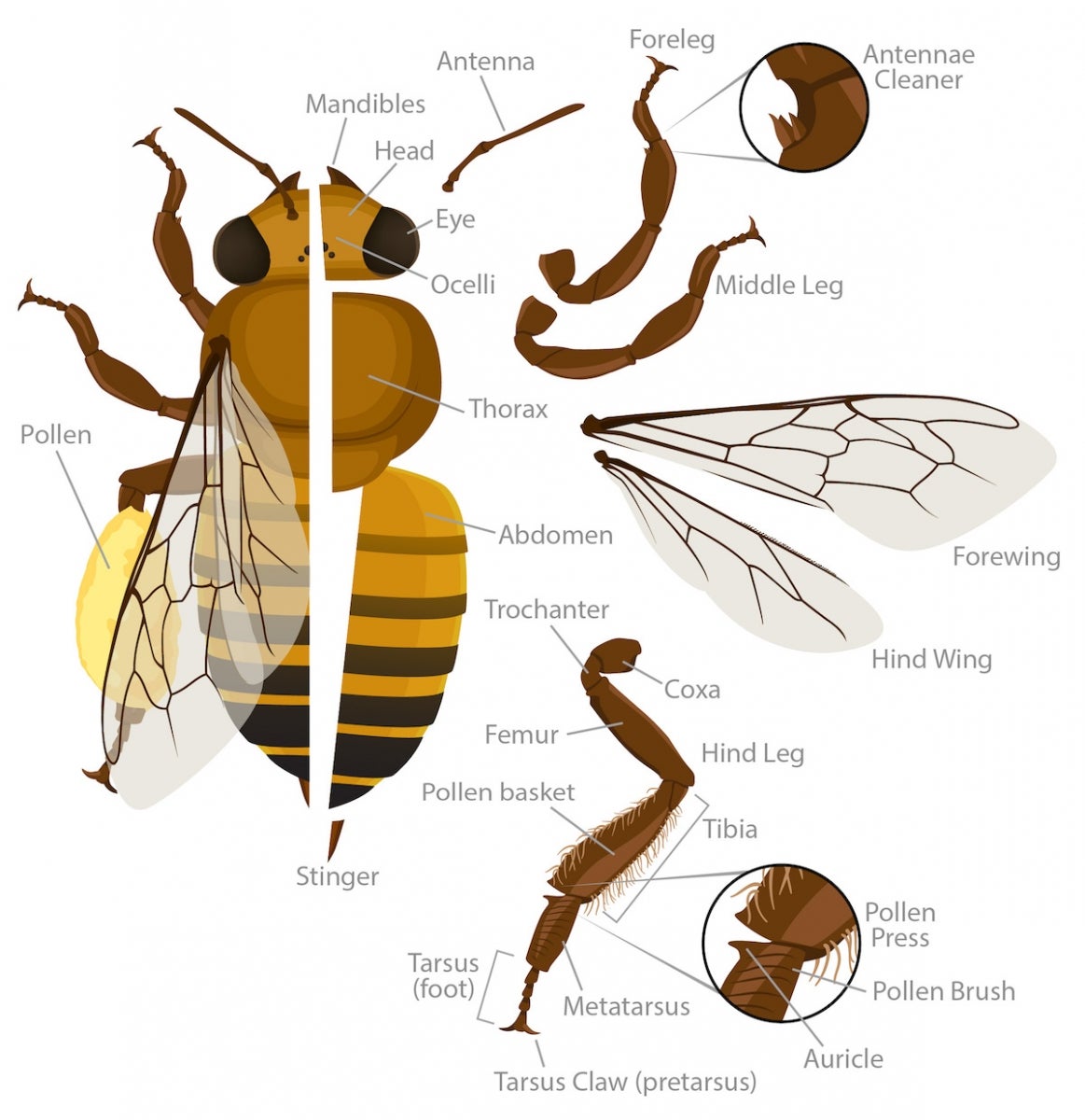
One of the first things that strikes us when observing a bee is its distinct body structure. Bees belong to the order Hymenoptera, which includes ants and wasps as well. They have three main body regions: the head, thorax, and abdomen. Let’s take a closer look at each of these regions.
1. The Head
The head of a bee is a fascinating structure that houses important sensory organs and structures essential for their survival. One prominent feature is the compound eyes, which are made up of many tiny individual lenses called ommatidia. These compound eyes allow bees to detect movement and perceive colors, helping them navigate and find food sources. Bees also have three simple eyes called ocelli, which primarily aid in sensing light intensity and direction.
Additionally, the head contains the bee’s mouthparts, including the mandibles and the proboscis. The mandibles, located on either side of the head, are responsible for tasks such as chewing and shaping beeswax. The proboscis, on the other hand, is a long, tube-like structure used for feeding on nectar and collecting pollen. It is a marvel of evolution, capable of extending and retracting to access flowers and extract their precious resources.
The head also houses the bee’s antennae, which play a crucial role in sensing the environment. Bees use their antennae to detect chemicals, communication signals from other bees, and even to perceive vibrations, helping them navigate and locate food sources.
2. The Thorax
The thorax is the middle region of a bee’s body and serves as the powerhouse, containing essential organs and adaptations for flight and foraging. The thorax is composed of three segments: the prothorax, mesothorax, and metathorax. Each segment contains a pair of legs, allowing bees to move and manipulate objects with precision.
One of the most striking features of a bee’s thorax is its large, strong wings. Bees have two pairs of wings – a larger pair in the front called forewings and a smaller pair in the back called hindwings. These wings enable bees to fly with incredible agility, hovering in the air, and maneuvering between flowers to gather pollen and nectar. The wings beat at a rapid rate, typically around 200 beats per second, enabling bees to achieve sustained flight.
Inside the thorax, bees have strong flight muscles that power their wings. These muscles, known as the indirect flight muscles, are attached to the exoskeleton and contract rapidly to generate the necessary force for flight. The thorax also contains respiratory organs called spiracles, which allow bees to exchange gases, taking in oxygen and releasing carbon dioxide.
Bee Anatomy: Sensory Systems and Communication
Beyond their body structure and adaptations, bees possess remarkable sensory systems that allow them to navigate their environments and communicate with fellow colony members. Understanding these sensory systems provides insights into the intricate biology of these pollinators.
1. Vision
Bees have excellent vision that aids them in finding flowers, navigating complex landscapes, and recognizing other bees. As mentioned earlier, bees have compound eyes composed of hundreds or even thousands of ommatidia. Each ommatidium collects information about a specific area of the visual field, and the brain processes this information to create a mosaic image. This mosaic allows bees to identify and remember visual patterns, such as flower shapes and colors.
In addition to vision, bees are also sensitive to ultraviolet (UV) light, which is invisible to humans. Many flowers have distinctive UV patterns, guiding bees to their nectar-rich centers. This ability to detect UV light gives bees an advantage in locating flowers and navigating complex environments.
2. Smell
The olfactory system of bees is another remarkable adaptation that plays a vital role in their biology. Bees have highly developed antennae equipped with numerous olfactory receptors. These receptors enable bees to detect and distinguish various scents, including floral scents rich in nectar and pollen.
Bees rely on their sense of smell to locate flowers from a distance and to communicate with their colony members. For example, when a foraging bee discovers a productive source of nectar, it can communicate the location of the flower to other bees by performing a dance known as the “waggle dance.” This dance conveys information about the direction and distance to the flower, allowing other bees to efficiently locate the food source.
3. Communication
Communication is fundamental in bee colonies, ensuring efficient division of labor and resource allocation. Bees communicate through a combination of chemical signals, tactile cues, and complex dances.
Chemical communication occurs through the use of pheromones, which are chemical substances produced by bees and released into the environment. Pheromones can convey various messages, such as marking a food source, signaling danger, or attracting mates. These chemical signals play a crucial role in coordinating activities within the colony and maintaining social order.
Tactile communication involves physical interactions between bees, facilitating the exchange of information. For example, bees may perform a “tandem run,” where a more experienced forager guides a younger bee to a food source, teaching it the route and location.
Lastly, the waggle dance is a fascinating and complex form of communication that allows bees to share information about the location and quality of food sources. Bees perform this dance on a vertical surface within the hive, moving in a distinctive pattern that conveys information about the direction and distance to the flower patch. Other bees observe and interpret the dance, enabling them to navigate directly to the food source.
Bee Anatomy: Nesting and Reproduction
Now that we have explored the fascinating aspects of bee anatomy and sensory systems, let’s delve into their nesting habits and reproductive cycle to complete our understanding of their biology.
Key Takeaways: Bee Anatomy
- Bee anatomy: the study of the body structure of bees.
- Bee body parts: head, thorax, abdomen, and six legs.
- Bee wings: the key to their ability to fly and pollinate.
- Bee antennae: used for sensing and communication.
- Bee mouthparts: specialized for collecting nectar and pollen.
Frequently Asked Questions
In this section, we will explore some common questions related to the anatomy of bees and how it contributes to their role as pollinators.
1. How are bees able to carry pollen on their bodies?
Bees have specialized body structures that help them in carrying pollen. One of these structures is the stiff hairs on their bodies, known as branched body hairs. These hairs create a rough surface that allows pollen grains to stick to them as bees move among flowers. Additionally, bees also have structures called pollen baskets or corbiculae on their hind legs. These are concave areas surrounded by long, stiff hairs that provide a convenient space for carrying pollen. As bees groom themselves, they transfer the pollen from their hairs to these baskets.
Pollen is an essential food source for bees as it provides them with the nutrients they need. By carrying pollen on their bodies, bees unintentionally transfer pollen from the male parts of a flower to the female parts, thereby facilitating pollination.
2. What is the role of bees’ mouthparts in pollination?
Bees have specialized mouthparts designed for collecting nectar and pollen, both of which play a crucial role in pollination. Their mouthparts consist of a long proboscis, which acts as a straw for sipping nectar from flowers. The proboscis is made up of several parts, including a flexible tongue-like structure called the glossa.
When bees visit a flower, they use their proboscis to sip nectar, while simultaneously brushing against the flower’s reproductive parts, such as the stamen and pistil. This contact allows pollen to stick to the bee’s body, ensuring its transfer to other flowers as the bee moves along. In this way, bees’ mouthparts facilitate the transfer of pollen, aiding in pollination.
3. How do bees see and navigate through their environment?
Bees have compound eyes that are made up of thousands of tiny lenses called ommatidia. These compound eyes allow bees to see a wide field of view and detect movements effectively. While they can’t see colors as accurately as humans, bees have a strong sensitivity to ultraviolet light, which is invisible to our eyes. They use this sensitivity to locate and identify different types of flowers that have unique ultraviolet patterns.
In addition to their compound eyes, bees also have three simple eyes called ocelli, positioned on the top of their head. These eyes help bees detect changes in light intensity and navigate based on the position of the sun. By combining the input from their compound eyes and ocelli, bees are able to navigate and forage effectively, helping them find the best sources of nectar and pollen.
4. What is the role of bees’ wings in pollination?
The primary role of bees’ wings is, of course, flight. However, their wings also play a secondary role in pollination. As bees move from flower to flower, their wings create air movement, which can cause pollen to be dislodged from the flower’s stamen. This airborne pollen can then settle on the pistil of the same flower or be carried to other flowers, facilitating cross-pollination.
Furthermore, bees’ wings also generate heat during flight, which helps maintain the bees’ body temperature. This is especially important for bees as they are cold-blooded insects. By regulating their body temperature, bees are able to maintain their energy levels and continue their vital role as pollinators.
5. How do bees communicate with each other during pollination?
Bees communicate with each other using a dance known as the “waggle dance.” This dance is performed by worker bees to communicate the location of a food source, including flowers rich in nectar and pollen. When a bee returns to the hive after finding a good food source, it performs the waggle dance on a vertical surface, such as the honeycomb. The dance consists of a figure-eight pattern, with the bee waggling its abdomen from side to side.
The direction of the waggle dance tells other bees the direction they need to fly in relation to the sun to find the food source. The duration of the waggle dance indicates the distance of the food source from the hive. By interpreting the information conveyed through the waggle dance, other bees in the hive can locate and visit the same food source, leading to efficient foraging and pollination.
The Power of Pollinators
Summary
If you want to understand bees better, you need to know about their anatomy. Bees have different body parts like the head, thorax, and abdomen. These amazing creatures also have special features like compound eyes, mouthparts for collecting nectar, and stingers for protection. Bee wings allow them to fly and the fuzzy hairs on their bodies help them gather pollen. Understanding the biology of bees can help us appreciate their important role as pollinators and how we can protect them. So next time you see a buzzing bee, remember all the cool things happening inside its tiny body!
 BeekeepingNET
Leave a comment